
“So, you’re saying that writing an online diary will increase my website sales? That doesn’t make any sense.”
Ever thought this? Well, that’s you and about 68% of all business owners, marketing managers, and podcasters that I’ve ever sat next to and attempted to lovingly bully into blogging.
Blogging is so ludicrously good for search engine optimisation (SEO). It’s almost like an over-powered marketing secret for massive traffic growth – except most people do kinda know about it, and I’d argue that it’s actually pretty darn appropriately-powered.
This article has a lot of pre-amble to set the scene, so let’s get to it.
What is SEO and what are SERFs
SEO is the process of optimising a website to rank higher and more often in search engine results, and most of the time that search engine we’re chatting about is Google. A larger quantity of higher appearances means more website visits, and ultimately more sales and more money too.
Visitors that start from a Google search tend to be amongst the most plentiful, most engaged, highest-spending and cheapest to acquire, so it’s well worth the investment.
There are different search engine ranking factors (SERFs) that impact how well a website performs, and most experts will group them into categories.
Now, because I am the most special of snowflakes, I use a slightly different SERF classification system which I’ve found helps non-SEO peeps better understand and implement good SEO practice.
Technical SEO factors
Google likes a reliable, fast, technically correct, and secure website. Technical SEO factors are those that impact site performance, and often a lot of people assume that when we talk about SEO, we’re only talking technical.
The very good news for the vast majority of website managers is that, these days and for the most part, technical SEO isn’t as much of a burden. In fact, if you run your website on an all-in-one platform like Squaresapce, Shopify, or Wix, there’s actually very little you can do to impact your own technical SEO.
I’m also not gonna chat about technical SEO much in this article, so you can totes forget about this section too if ya like.
Content SEO factors
How does Google know what your brand sells and who might wanna buy it? It doesn’t, unless you write it on your website.
Google massively relies on the content on your website – as do your customers. I love a lil SEO catch-phrasing – especially when I’m posting bitesize advice over on my Studio Cotton Instagram profile – so here are a handful of very relevant Aimeisms to mull over:
- If you wanna rank for something, you’ve gotta write that something on your website
- You’ll never appear in Google search results for something that isn’t written on your website
- Nobody else is going to tell Google what you do or who you do it for. If you don’t write it, Google can’t know it.
When someone is working on their content SEO, what they usually mean is that they’re making sure that the website clearly reflects the breadth of their brand for their audience, and it structured in a way that helps Google and customers to find the information they need.
Context SEO factors
This is my special SERF category. Unlike technical SEO and content SEO, context SEO is not fully within the control of the website owner.
Context SEO puts a website, well, in context – by looking at how it relates to its users and other brands/websites. For example, website engagement is a massive context SERF.
Imagine 2 websites, alpha-tooties.co.uk and beta-snooties.co.uk – they’re exactly the same except the visitors on beta-snooties.co.uk stay on the site longer, view more pages, and click on more stuff.
From Google’s POV, beta-snooties.co.uk is the more active and well-used website, so it’s more likely to rank it above (or instead of) alpha-tooties.co.uk.
When we’re working on our context SEO, we’re often looking at ways to keep our audience engaging with our website as well as building connections to other people, brands, & organisations.
What is blogging for business (and why your understanding might be wrong)
In ye early days of email, big businesses would send out epic broadcasts with all of their brand news. Over a couple of decades, these long, dry newsletters became the highly-commercialised and highly-profitable marketing emails we get today. That’s why when we think of marketing emails, we probably don’t picture those original long, dry broadcasts.
In ye early days of blogging, people and businesses would document their experiences, ideas, activities and feelings into a sorta online diary – a web log, or blog.
And then blogging evolved to something more commercialised and profitable. However, unlike email marketing, the perception of blogging from the general population has stayed the same, especially with us millennials and earlier generations.
A strategic brand blog is way less diaristic (a term I totes had to Google), and way more focused on the publishing of content that attracts, engages, and entertains a target audience.
In short, just writing a diary on your website is unlikely to benefit your business, but here’s why strategic blogging boosts your website SEO.
1. Blogging adds more words to your website
Like I said, Google relies on the words you’ve written on your website to match you with different searchers and their queries.
Blogs are wordy as heck. So many words. Like right now I’ve already written 855 words in this very blog and I’ve barely started.
Wordiness adds way more weight and evidence to your website, which is good for everyone and GREAT for those brands with a more sparse website. Basically, a reliable way to tick a fluffin’ massive content SEO checkbox.
PS. If you need to make your blogs longer and wordier, check out 7 easy tips and tricks for writing longer blogs.
2. Blogging adds more pages to your website
Every page on your website has the potential to appear in Google search results, and every time you hit publish on a blog post – BOOM – new page.
Again this is a huge blogging bonus for a service business like mine. Without our blog articles, our website could probably cover our services over about 8 pages.
With our blog articles, we’ve got nearly 200. That’s 25x more opportunities to show up.
3. Blog pages can directly answer Google search queries
Every page in a list of Google search results is a potential answer to the searcher’s query. The more aligned that page is with the searcher and their search query, in theory, the higher the page will appear in those results.
Thing is, our potential customers are Googling a plethora of topics and questions that we could help them with, and we wanna show up for. Without a blog, there just isn’t enough room.
Let’s say you’re a copywriter & copy editor, and have one page on your website that mentions you offer social media content.
Well, your dream customer – Clive – has just Googled “Proofreader ghost writer LinkedIn Substack” because he ideally wants to outsource some content creation and has no idea if this is even a service.
But alas, “Social media management” and “Proofreader ghost writer LinkedIn Substack” don’t share any language, so it’s unlikely that you’d show up in Clive’s search results.
However, you could show up with blog articles like:
- 5 easy tips for proofreading and copy editing Substack content
- How to outsource your personal LinkedIn posts to a copywriter (and stay authentic)
- 8 ways a professional proofreader can increase the effectiveness of your LinkedIn posts
4. Blogging gives you the chance to do a deep-dive on a specialised topic
I love a deep-dive – I’m literally writing one right now. Deep-dives are great for allowing a writer to demonstrate their expertise, build trustworthiness, and strengthen their relationship with a reader.
They have the added SEO benefit of being laden with phrases that tend to match a lot of search queries, and that don’t have many other people writing about them.
For example, here at Studio Cotton I have basically zero chance of our website appearing in Google search results for “Website tips” – it’s too generic, and about 7,456,472,987 other web pages exist around this topic.
So I started my Website tips for… blog series where I share specific, nuanced tips for different types of business – from jewellery to podcasts to coffee shops – and from these articles we’ve picked up over 100,000 search impressions in the last 12 months.
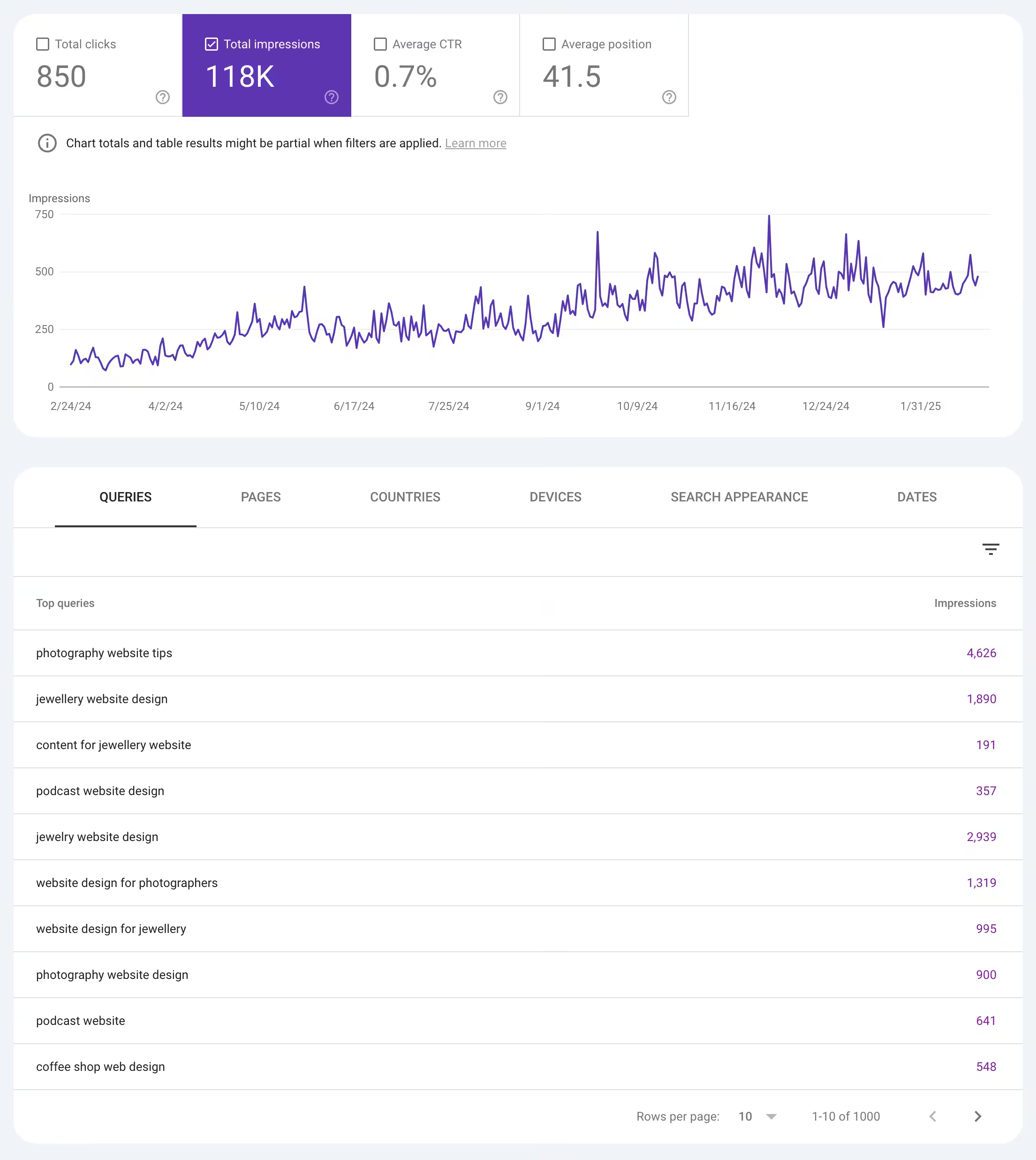
Without a blog, I wouldn’t have had any chance pick up phrases like “website design for photographers” or “content for jewellery website” – thus missing out on getting in front of all these people who need website help.
And I love sharing website help.
PS. Yeah – those clicks are a bit lower than I’d like too. Gotta keep swimming though.
5. Local SEO
Google loves pairing local searchers with local results. Like if I’m in the office and rainwater starts pouring through our bathroom light fittings, I want Google to show me an emergency builder in Bristol – not Blackpool.
True story by the way. Thankfully these days our loo is much dryer.
So it’s a really good idea to make it really REALLY obvious to Google where you are, so it can send you an extra dollop of traffic from your potential local customers.
Yep – even if you sell around the globe.
Spending time on your local SEO does NOT prevent you from ranking elsewhere, it just gets you even more visitors from your neighbours. There is no downside.
But how the fluff can you maximise your localness without writing BRISTOL BRISTOL BRISTOL BRISTOL all over your website? Well, you can blog blog about Bristol. I mean – you can blog about your own local area.
That’s exactly why I tasked our content producer and in-house blogger Lyzi to write up a rundown of 15 cool cafés and coffee shops for client meetings in Bristol, which became one of our highest reach articles in 2024.
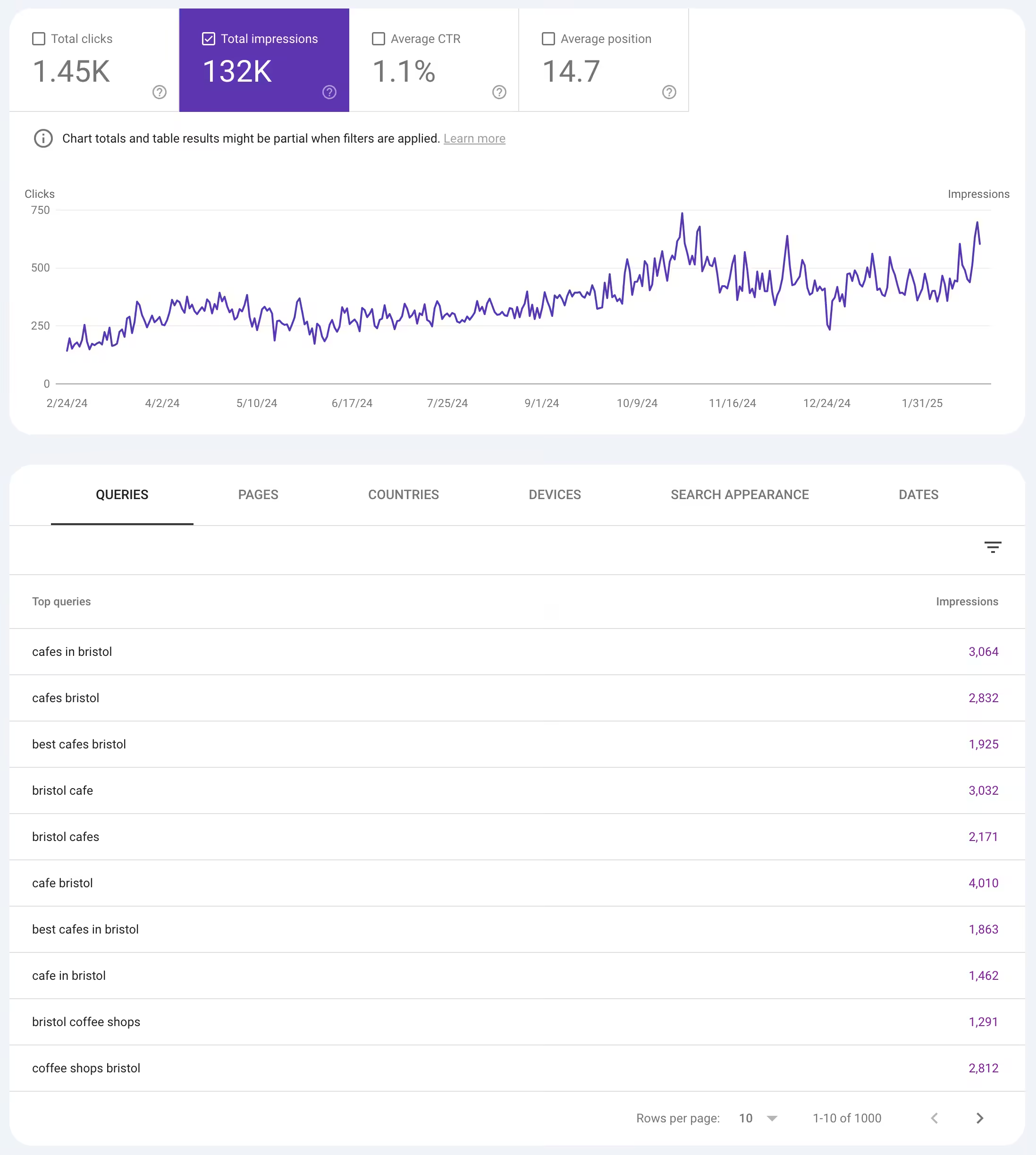
Now am I bitter that this one article generated more impressions and clicks than my whole Website tips for… series? Yeah*. But don’t tell Lyzi. Except I’m totes getting Lyzi to proofread this blog. So. Sorry Lyzi.
*Ok I couldn’t actually end this section without clarifying that I’m not actually salty because the queries that originated from the Website tips for… articles are much more closely aligned with our services and therefore more likely to benefit Studio Cotton in the long-run, so that’s actually a-ok.
6. Blogs take ages to read
Right, we’ve covered most of the content-SEO-boosting tips, now lets look at context SEO.
The amount of seconds and minutes spent on a website is known as dwell time. High dwell time is known to be good for SEO because, well, it means humans are engaging with the content on page and a website. If humans like it, Google likes it.
Blog articles take minutes to read – compared to the seconds that users usually spend on a home page, product page, or service.
That means that an active blog can aggregate a huge amount of site-wide dwell time, and that those 53 people who read your latest rundown of your city’s fanciest coffee shops are helping your home page to rank higher – even if they never even saw it. Magic.
7. Blogs are an easy-ish way to get another page visit
Pages Per Visit (PPV) is a bit of an old-school website metric, but as a rule of thumb – a higher PPV is still a good sign that your website is engaging, and an engaging website is something that we know helps a website to rank higher.
Which also makes sense, because someone visiting two pages on your website is a more positive signal than someone visiting just one page on your website.
Blog articles can be a great way to turn that one-page visit into a two-page visit IF you make sure to include plenty of links to other articles and pages on your website – these are also known as internal links.
Adding internal links is something that’s always at the front of my mind when I’m blogging, and I bet you didn’t even notice an abundance of links in this article until right now because I am oh-so subtle.
8. Blogs drive traffic from social media & email
Google prefers a busy website to a quiet one, and sometimes that means brands having to go out of their way to push visitors towards their website.
Now obvs, it’s much more commercially beneficial to push customers towards a product or service they can purchase.
But. There are plenty of people in every brand’s audience who are not going to make a purchase – at least not now – and a blog allows you to have that website-visiting reason.
In my own experience, links to our blog articles are nearly always the most clicked in our marketing emails – and if you wanna turn your blogs into traffic-driving content machines, check out 13 smart ways to promote that totally brilliant blog post that you’ve just published.
9. SEO Backlinks: blog articles give other websites something to link to
A backlink is a link from any other website to your website, and Google uses them as little stamps of approval that add legitimacy to your brand. Without backlinks, any website will struggle to make any real headway with their SEO.
And yet, how do you get other websites to link to you? Luckily, I’ve got another article for you, a guest post I wrote for Bristol Market: SEO backlinks for beginners: Why? Where? How?! Please?!!!.
However, once you’re out of these easy & beginner links – you’re left with the harder ones. And, a blog makes those harder ones a little less hard.
Blog articles can be cited and referenced by other websites – especially if you use your blog to write about other businesses with blogs.
PS. Wanna check this status of your backlinks? Here’s my go-to free checker from Ahrefs, as featured in another of my articles, 7 FREE SEO tools I check when someone tells me their SEO sucks.
10. Demonstrating Google’s values of EEAT
I was in two minds about adding EEAT into this article because it’s really hard to empirically review or measure how this directly impacts the SEO of an individual website.
EEAT stands for Expertise, Experience, Authority and Trustworthiness – and they are Google’s published qualities for creating website content that ranks well.
Basically, Google says that they want their search results to be filled with web pages that described the experiences of real people, with genuine expertise from trustworthy sources, that have demonstrated their authority.
Which sounds lush, but like – how do you tell Google that you’re mega trustworthy? How do you measure an experience?
Ok, blogging is definitely a great platform for sharing your experience and expertise, but when it comes to EEAT, it’s good to keep in mind that this is Google’s goal, and it’s using all those other SERFs to try and achieve it.
That’s why I want you to bear EEAT in mind, but if you wanna make a big impact on your SEO with blogging, ya need to hit those SERFs first and foremost.
11. Structured content and lovely lovely H2 headings
Ok, I’m ending on a technical SEO tidbit. Every page on your website needs a single heading or title – marked as a Heading 1 or H1. Then every single page should be broken into sections, each starting with a subheading or Heading 2.
If one of those sections needs break into subsections, then you’d use Heading 3s.
They form a bit of a content hierarchy, with the Heading 1 at the top of your content hierarchy, and your paragraph text making up the very important foundations.
However, most DIY websites and an uncomfortable quantity of professional website totally balls these up. They use them in the wrong places, the wrong order, the wrong quantity.
This balls-ing up often throws the wrong info to the top of their hierarchy, and sends a very confusing picture to Google.
However. In my experience, brands do tend to be a little better at implementing this heading hierarchy in their blog posts, using heading 2s appropriately at the beginning of each blog section – just like I’ve done in this one today.
So basically, blog articles can be a type of content with a really clean structure, which is another quality Google loves to see.
And that’s it. Blogging is ludicrously good for SEO because it ticks an absolute tonne of positive SEO checkboxes. However, ya need to know these checkboxes – and the more knowledgeable, strategic, and persistent you blog, the better it tends to pay off.
So now you know why you should blog, let’s get you started with some tips on how to blog. Here’s some more articles from me and my team so I can try to earn that second-page click from you too 😉